Make a Call
Drop us a Line
In industrial and construction environments, operator protection is paramount. Every year, thousands of workplace accidents involve heavy machinery and pedestrians, leading to serious injuries and fatalities. According to the U.S. Occupational Safety and Health Administration (OSHA), struck-by incidents account for approximately 18% of all construction fatalities. While traditional safety alarms have been the standard for hazard alerts, proximity warning and alarm systems (PWAS) are rapidly becoming the smarter, more effective solution to reduce these risks.
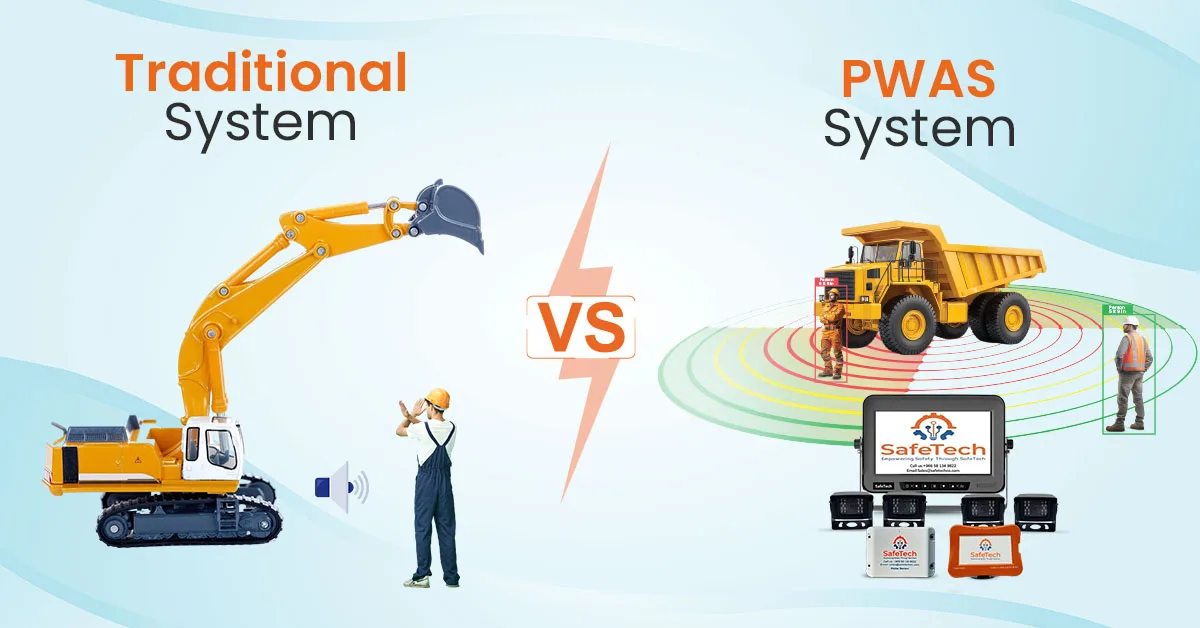
Traditional safety alarms generally depend on auditory cues such as horns, bells, or sirens. These alarms activate broadly, warning everyone within range regardless of their actual risk exposure. This approach often causes:
Frequent false or non-specific alarms desensitize workers, leading to delayed or ignored responses.
Traditional alarms cannot distinguish between pedestrians and other moving objects, reducing alert relevancy.
Frequent, unnecessary alarms can disrupt workflow, slowing operations without enhancing safety.
Proximity warning and alarm systems (PWAS) employ advanced sensor technologies—radar, LiDAR, cameras, and infrared detectors—to detect the exact presence of pedestrians and operators near heavy machinery. PWAS provide precise, real-time alerts tailored to the situation.
Studies show that sensor-based systems reduce false alarms by up to 60%, improving worker trust and responsiveness.
Facilities using PWAS report up to a 40% decrease in struck-by and collision incidents.
Integration with vehicle controls can reduce equipment speed by 20-50% when pedestrians enter danger zones, greatly reducing injury severity.
Combining audible, visual, and haptic warnings increases operator and pedestrian awareness by over 30% compared to sound-only alarms.
PWAS alerts are triggered only when a pedestrian or operator is within a predefined safety zone, reducing unnecessary interruptions and alarm fatigue.
Real-time monitoring allows operators to see exactly where pedestrians are located, improving decision-making and reaction times.
Many PWAS can automatically slow or stop machinery, providing a critical safety layer beyond human reaction.
PWAS often include data logging for compliance audits and incident investigations, supporting continuous safety improvements.
Beyond human safety, reducing accidents lowers costs related to downtime, insurance claims, and regulatory fines, providing a tangible return on investment.
A recent survey found that over 70% of large construction firms plan to invest in proximity warning technologies within the next five years.
The global market for industrial safety systems, including PWAS, is expected to grow at a CAGR of over 10% through 2030, driven by stricter safety regulations and technological advancements.
While traditional safety alarms have served workplaces for decades, the increasing complexity and risk in industrial environments demand advanced solutions. Proximity warning and alarm systems combine precision, automation, and multi-sensory alerts to significantly enhance operator protection and heavy machinery safety.
Investing in PWAS is not just about meeting safety standards—it’s about saving lives, improving productivity, and fostering a proactive safety culture that benefits everyone on site.
Your trusted partner for AI-Powered Proximity Warning Systems, LMI solutions, GPS tracking, and industrial safety technology across the Kingdom.
SAFE TECH : Pioneering Industrial Safety in Saudi Arabia